Retaining wall drainage with geotextile.
Water trapped behind a retaining wall pushes on it, and soil washing out through the weep holes leaves voids behind it. A gravel drainage zone wrapped in non-woven geotextile lets the water out and keeps the soil in.
The short answer
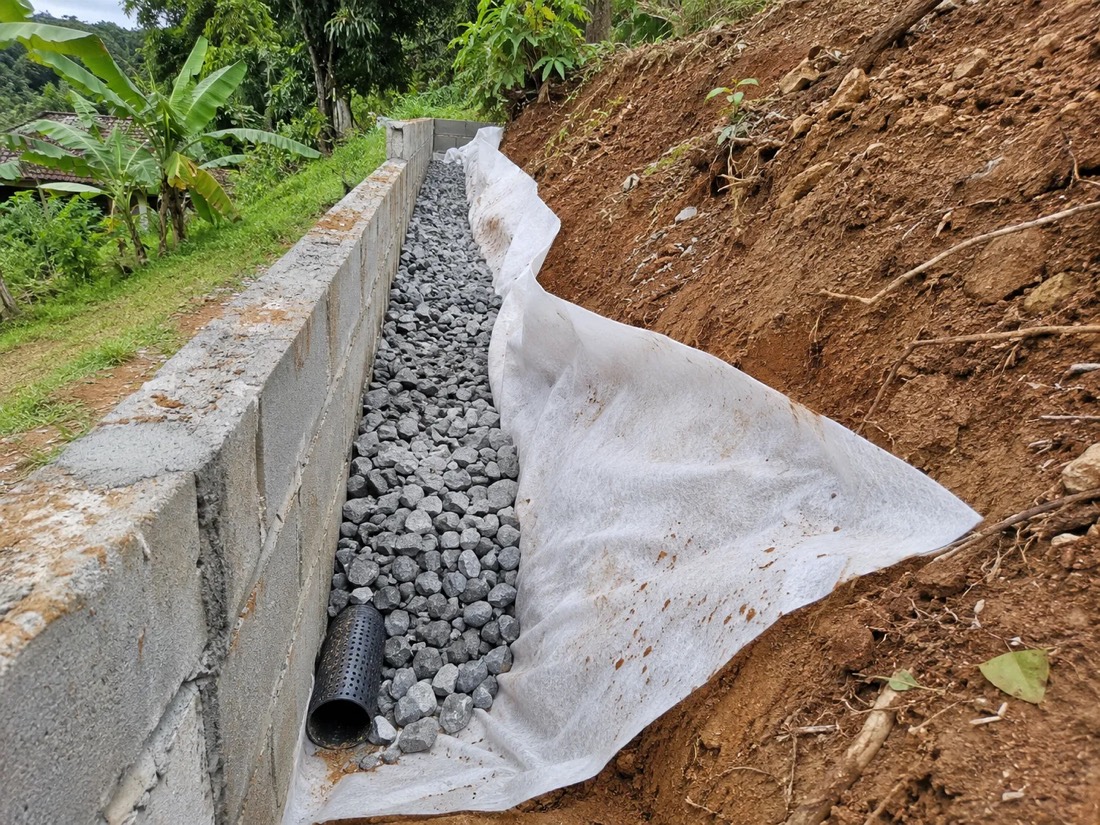
Behind the wall, build a zone of clean gravel about 300 mm wide from the base to near the top, with a perforated pipe or weep holes at the bottom. Line the soil side of that gravel with non-woven geotextile, so water gets in and soil doesn't. 130 to 150 gsm (ATX20, ATX30) is the usual grade.
What goes behind a retaining wall.
The geotextile separates the backfill soil from the drainage gravel. Water seeps through the fabric into the gravel, runs down to the pipe or weep holes and out. The soil stays behind the fabric, so the gravel and the outlets don't clog.
- Retaining wall
- Clean gravel drainage zone
- Non-woven geotextile
- Backfill soil
- Perforated pipe or weep holes
How to build it, step by step.
Plan the outlet
Decide where the water leaves: weep holes through the wall, a perforated pipe at the base running to a drain, or both.
Lay the base pipe
If you use a pipe, lay a perforated pipe on a gravel bed at the back of the wall footing, falling to its outlet.
Place the geotextile
Lay the fabric along the base and up the soil side of the drainage zone, leaving enough at the top to fold over. Overlap joins by 300 mm.
Cover the weep holes
Where there are weep holes, make sure fabric-wrapped gravel sits behind each one so soil can't wash out through it.
Fill with gravel as the backfill rises
Bring the gravel zone (about 300 mm wide) and the soil backfill up together in layers, compacting the soil lightly. Keep the fabric between them.
Fold over the top
Near the top, fold the fabric over the gravel and cap it with compacted soil so surface water and soil don't run straight in.
Finish the surface
Finish with soil and turf, or a surface drain, sloped away from the top of the wall.
How much fabric per metre of wall?
The fabric runs along the base, up the soil side of the gravel and over the top. As a rule of thumb, you need a strip about the wall height plus 1 m.
| Wall height | How to lay the 2 m roll | Fabric per 10 m of wall |
|---|---|---|
| 0.6 m | one strip along the wall | about 10.5 m of roll |
| 1.0 m | one strip along the wall | about 10.5 m of roll |
| 1.5 m | 2.5 m pieces laid up the wall | about 16 m of roll |
| 2.0 m | 3 m pieces laid up the wall | about 19 m of roll |
Walls holding back more than a small garden level need an engineer's design; follow their drainage detail and fabric specification.
Which grade for retaining wall drainage?
The fabric is a filter here, so a light to medium grade is right. Go heavier where rough stone presses against it.
- Garden and boundary walls
- 130 gsm (ATX20), made in Seremban and in stock.
- Rough or angular drainage stone
- 150 to 190 gsm (ATX30, ATX40), to order.
- Engineered walls
- Use the grade in the engineer's specification.
- Roll sizes
- ATX20: 2 m × 100 m and 2 m × 250 m, from a single roll.
- Catalogue
- Download the AeroTex catalogue (includes the data sheet). Test reports on request.
Why retaining walls crack and leak mud.
Water and washed-out soil cause most retaining wall problems.
- No drainage behind the wall · water builds up and pushes on the wall
- Weep holes with nothing behind them · soil washes out, leaving voids and muddy stains
- Gravel with no fabric · soil migrates into the gravel and it stops draining
- Clay backfill straight against the wall · it holds water and swells
- Surface water running over the top · it soaks straight down behind the wall
Weep holes or a pipe?
Weep holes are simple and common on garden walls, but each one needs filtered gravel behind it or it will leak soil.
A perforated pipe along the base collects water from the whole length and takes it to a drain, which keeps the face of the wall clean. Many walls use both. It is the same idea as a French drain, stood up behind the wall.
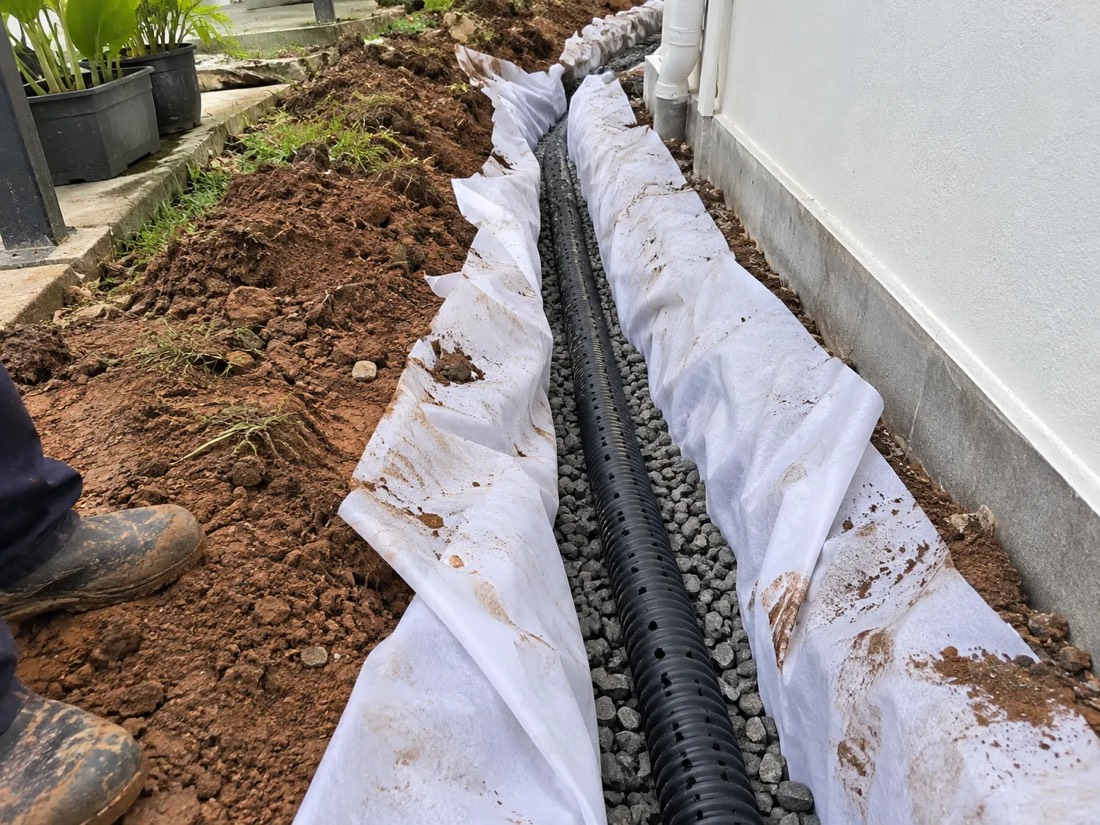
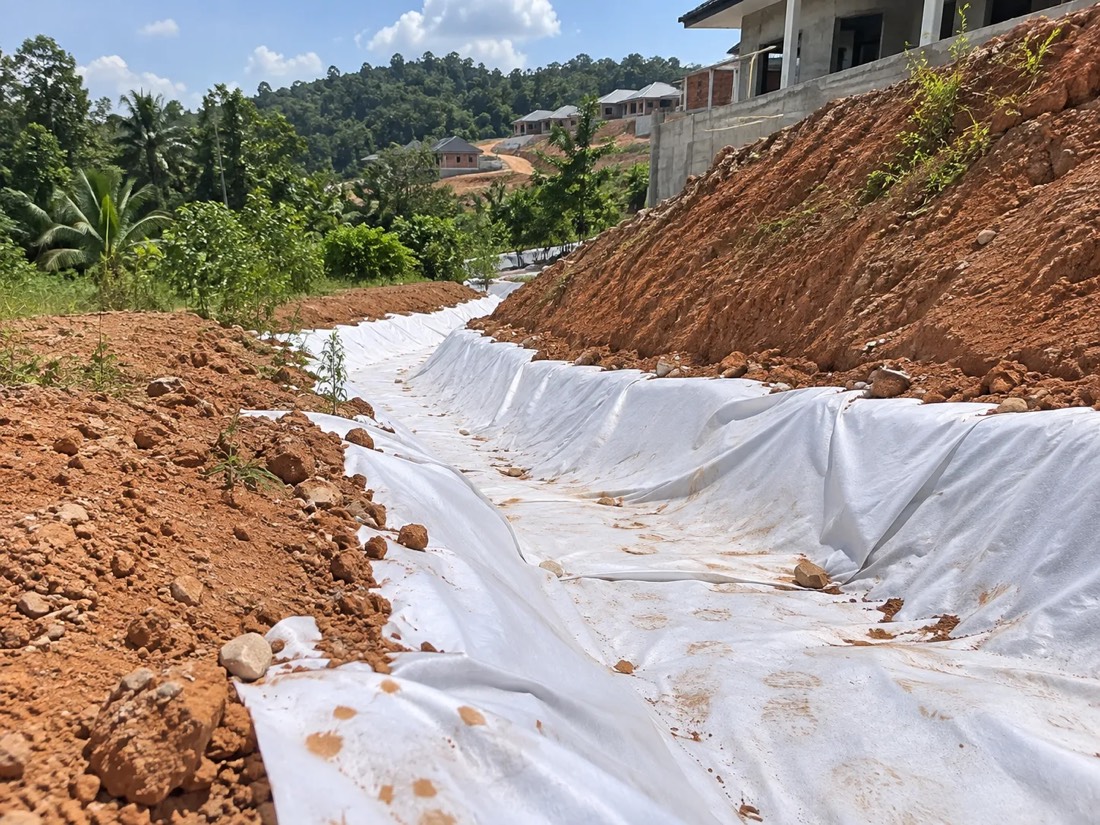
Retaining walls and drains our customers have built.
Retaining wall questions.
Do retaining walls need geotextile?
If the wall has a gravel drainage zone or weep holes, yes. The geotextile keeps the backfill soil out of the gravel and the outlets, so the drainage keeps working.
Where does the geotextile go behind a retaining wall?
Between the backfill soil and the gravel drainage zone: along the base, up the soil side of the gravel and folded over the top. It doesn't go against the back of the wall itself.
What gsm geotextile for a retaining wall?
130 to 150 gsm (ATX20, ATX30) for garden and boundary walls. Use 190 gsm or the engineer's grade where rough stone or higher walls are involved.
How wide should the gravel drainage zone be?
About 300 mm is common for garden walls. Follow the engineer's detail for anything larger.
Should geotextile cover the weep holes?
Fabric-wrapped gravel should sit behind each weep hole, so water gets out but soil doesn't. Don't block the hole itself.
Woven or non-woven for retaining wall drainage?
Non-woven. It lets water through across the whole sheet and holds fine soil back. See woven vs non-woven.
Where can I buy geotextile for a retaining wall in Malaysia?
AeroTex makes ATX20 in Seremban and sells from a single roll with nationwide delivery. Send the wall length and height on WhatsApp for a price.
Building a retaining wall? Send us the size.
Tell us the wall length, height and delivery location. We reply with the grade, how much fabric and today's price.
 © 2026 AeroTex™ Non-woven Geotextile. Made in Malaysia.
aerotex.my