How to build a French drain or subsoil drain with geotextile.
A French drain is a gravel trench, usually with a perforated pipe, that collects groundwater and carries it away. Wrapping the trench in non-woven geotextile lets water in and keeps soil out, so the drain doesn't clog. This guide covers the build, the fabric grade and how much fabric you need.
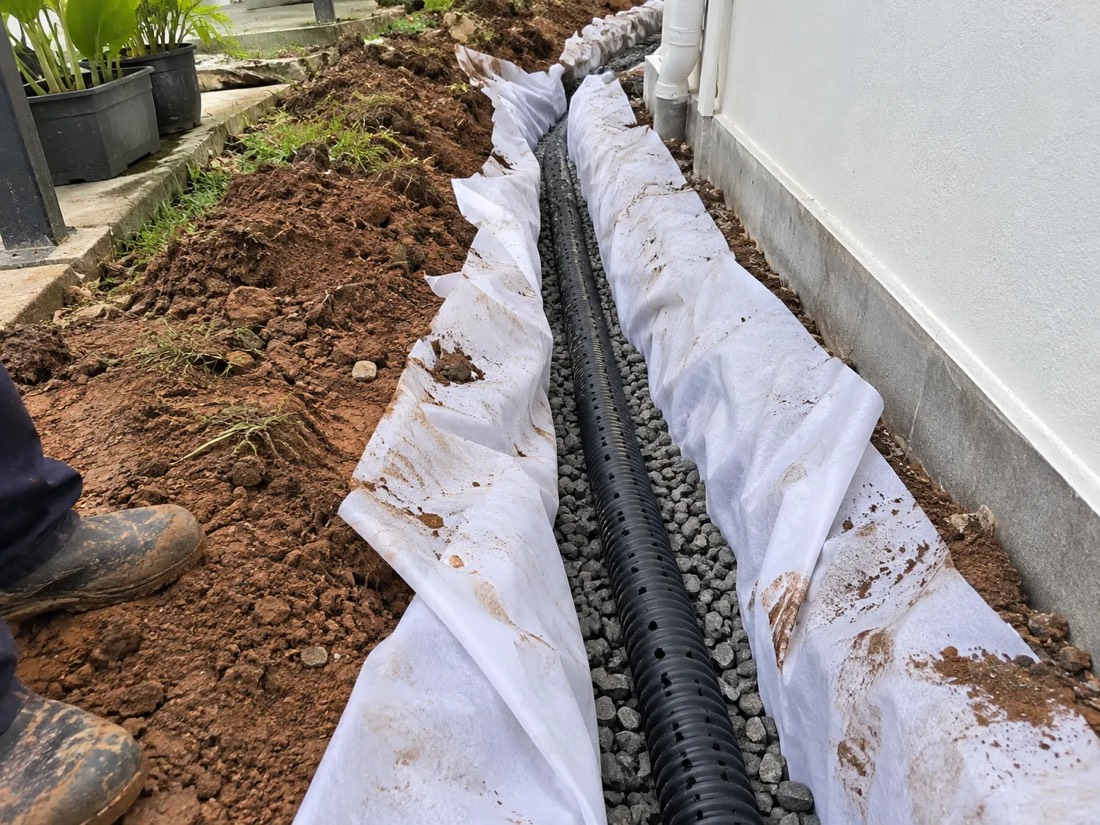
The short answer
Dig a trench with a slight fall, line it with non-woven geotextile, add a bed of clean gravel, lay a perforated pipe, cover it with more gravel, then fold the fabric over the top with an overlap before backfilling. For most house and garden drains, a 130 to 150 gsm non-woven geotextile is the usual grade.
What a French drain looks like inside.
The geotextile wraps the whole gravel pack, not just the pipe. Water passes through the fabric; the fine soil that would block the gravel and the pipe stays outside.
- Surrounding soil
- Non-woven geotextile, overlapped at the top
- Clean gravel or aggregate
- Perforated pipe
- Topsoil, turf or pebbles
How to build it, step by step.
Plan the route and the fall
Run the drain from the wet area to a safe outlet such as a monsoon drain or sump. Give the trench a steady downhill fall so water keeps moving; a common rule of thumb is about 1 cm drop for every metre of length.
Dig the trench
For house and garden drains, trenches are typically around 300 mm wide and 300 to 600 mm deep. Keep the bottom even so the pipe doesn't sag and hold water.
Line the trench with geotextile
Lay the non-woven geotextile across the trench so it covers the bottom and both sides, with enough left at the top to fold over and overlap. Push it into the corners; don't stretch it tight. Where two pieces meet along the trench, overlap them by about 300 mm.
Add a gravel bed
Put a layer of clean gravel or aggregate in the bottom, roughly 50 to 100 mm, and level it to the fall.
Lay the perforated pipe
Lay the perforated pipe on the gravel bed and connect it to the outlet. Check the fall again before you cover it.
Fill with gravel
Cover the pipe with more clean gravel, up to the level where the topsoil or surface layer will start.
Fold and overlap the fabric
Fold both sides of the geotextile over the top of the gravel so they overlap. This stops soil washing down into the gravel from above.
Backfill and finish
Cover with topsoil, turf, pebbles or paving. In a pebble garden you can leave the gravel showing so surface water enters directly.
Which roll width do you need?
To wrap a trench, the fabric must go down one side, across the bottom, up the other side, across the top and overlap. Add those up and pick the roll width that covers it.
| Trench (width × depth) | Fabric width needed | Roll width |
|---|---|---|
| 300 × 300 mm | 1.5 m | 2 m |
| 300 × 450 mm | 1.8 m | 2 m |
| 300 × 600 mm | 2.1 m | 2 m, laid across |
| 450 × 450 mm | 2.1 m | 2 m, laid across |
| 450 × 600 mm | 2.4 m | 2 m, laid across |
| 600 × 600 mm | 2.7 m | 2 m, laid across |
Run along the trench, a 100 m roll wraps about 100 m of trench. ATX20 rolls come 2 m wide, in 100 m and 250 m lengths, from a single roll. For open areas rather than trenches, use the roll calculator.
Which geotextile for a French drain?
Use a non-woven geotextile. Its felt-like structure lets water through across the whole sheet while holding fine soil back, which is the job a drain needs.
- House and garden drains
- 130 to 150 gsm. Our ATX20 is in this class and is the TS20-equivalent grade.
- Light grades
- 130 to 150 gsm (ATX20, ATX30) covers French drains, subsoil drains, planter boxes and garden beds.
- Slope drains and channels
- 190 to 250 gsm (ATX40 to ATX60), where the fabric takes more wear from stone and flowing water.
- Catalogue
- Download the AeroTex catalogue (includes the data sheet). Test reports on request.
Mistakes that make drains clog.
Most French drains that stop working fail for one of these reasons.
- No fabric around the gravel · soil migrates into the gravel and the pipe fills with silt
- No overlap at the top · soil washes down into the gravel from above
- No fall, or a dip in the pipe · water sits in the drain instead of leaving
- Dirty gravel or sand fill · fines block the gaps that water needs
- Torn fabric left in place · patch it with an overlapping piece before filling
French drain or subsoil drain?
The two names describe the same idea: a perforated pipe in a gravel trench, wrapped in geotextile, that lowers groundwater and carries it away. "French drain" is the common name for house and garden jobs. "Subsoil drain" is the term you'll see on construction drawings for drains under roads, fields, car parks and behind retaining walls.
The build is the same. Subsoil drains on bigger jobs are often deeper and wider, so check the table above for the roll width, and follow the engineer's drawing where there is one.
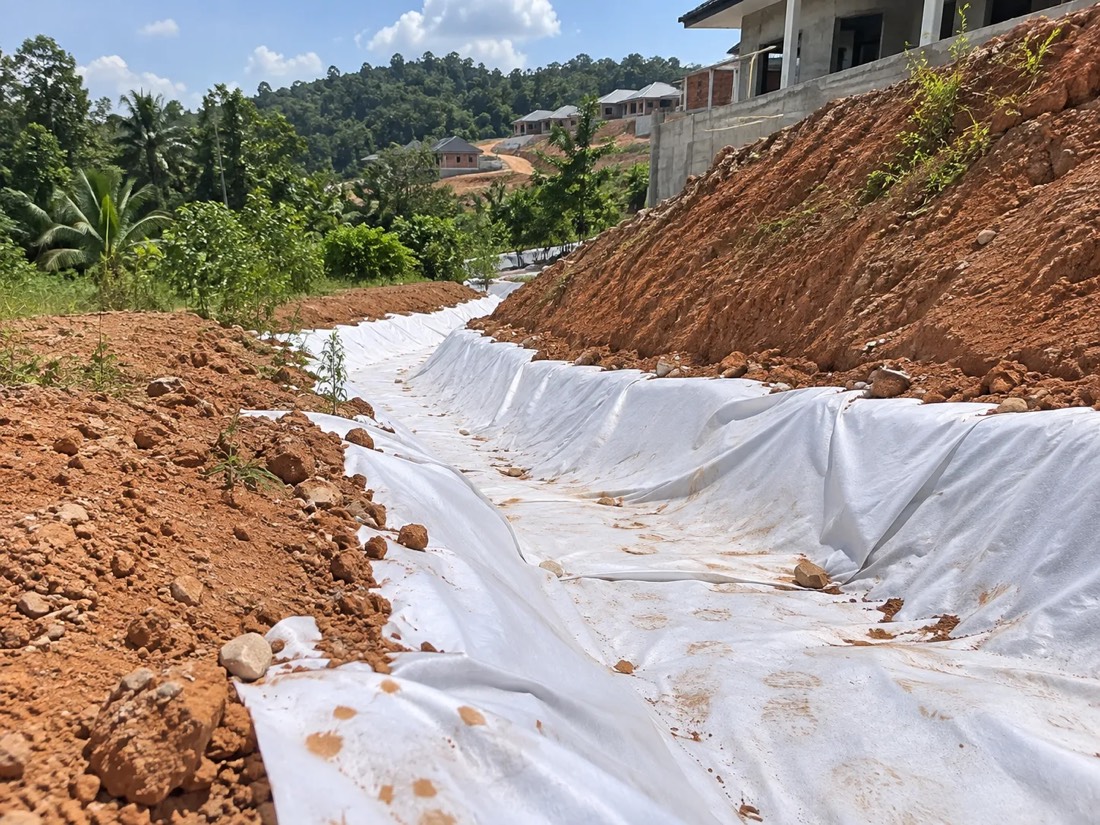
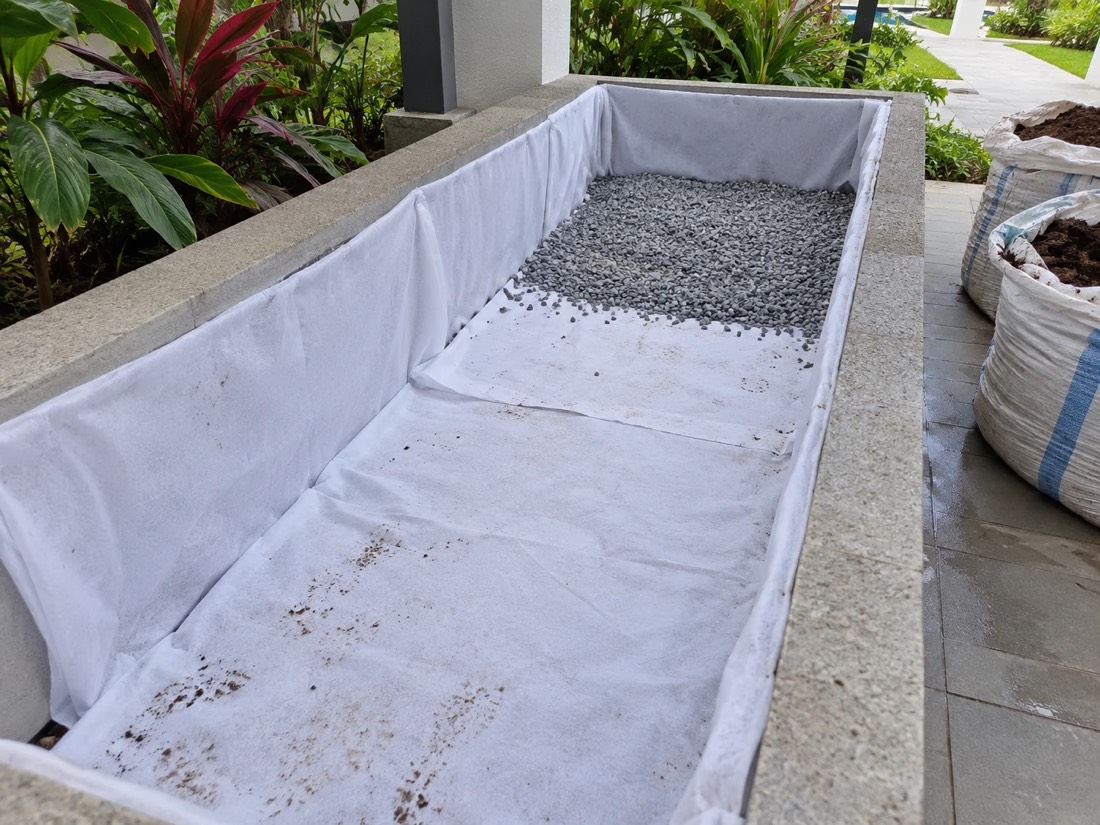
Drains our customers have built.
French drain questions.
Do I need geotextile for a French drain?
Yes, in almost all soils. Without it, fine soil washes into the gravel and the pipe, and the drain slowly clogs. Wrapping the gravel pack in non-woven geotextile keeps the soil out while letting water in.
Should the fabric go around the pipe or around the trench?
Around the trench. Line the whole trench, fill it with gravel and the pipe, then fold the fabric over the top. That keeps soil out of the gravel as well as the pipe.
What gsm geotextile should I use for a French drain?
For house and garden drains, 130 to 150 gsm non-woven geotextile is the usual choice. Slope drains and channels that take more wear use 190 to 250 gsm (ATX40 to ATX60).
Woven or non-woven geotextile for drains?
Non-woven. It lets water through across the whole sheet and holds fine soil back, which is what a drain needs. AeroTex makes non-woven geotextile only. More in woven vs non-woven geotextile.
How much geotextile do I need for my drain?
Fabric width is twice the depth plus twice the width plus about 300 mm overlap. A 300 × 450 mm trench needs about 1.8 m, so a 2 m roll run along the trench. For deeper or wider trenches, cut pieces off the 2 m roll and lay them across the trench with 300 mm overlaps. Allow extra length for joints.
Where can I buy geotextile for a French drain in Malaysia?
AeroTex makes non-woven geotextile at its plant in Bandar Sri Sendayan, Seremban, and sells from a single roll with nationwide delivery. Send your trench size and location on WhatsApp for a price.
Building a drain? Send us the trench size.
Tell us the trench width, depth, length and delivery location. We reply with the roll width you need, today's price and a delivery date.
 © 2026 AeroTex™ Non-woven Geotextile. Made in Malaysia.
aerotex.my