Geotextile for slope drains and slope protection.
Rain running down a slope washes soil out from under drains, stone pitching and rock protection, until they crack and slide. Non-woven geotextile laid under the stone or behind the drain keeps the soil in place while letting water through.
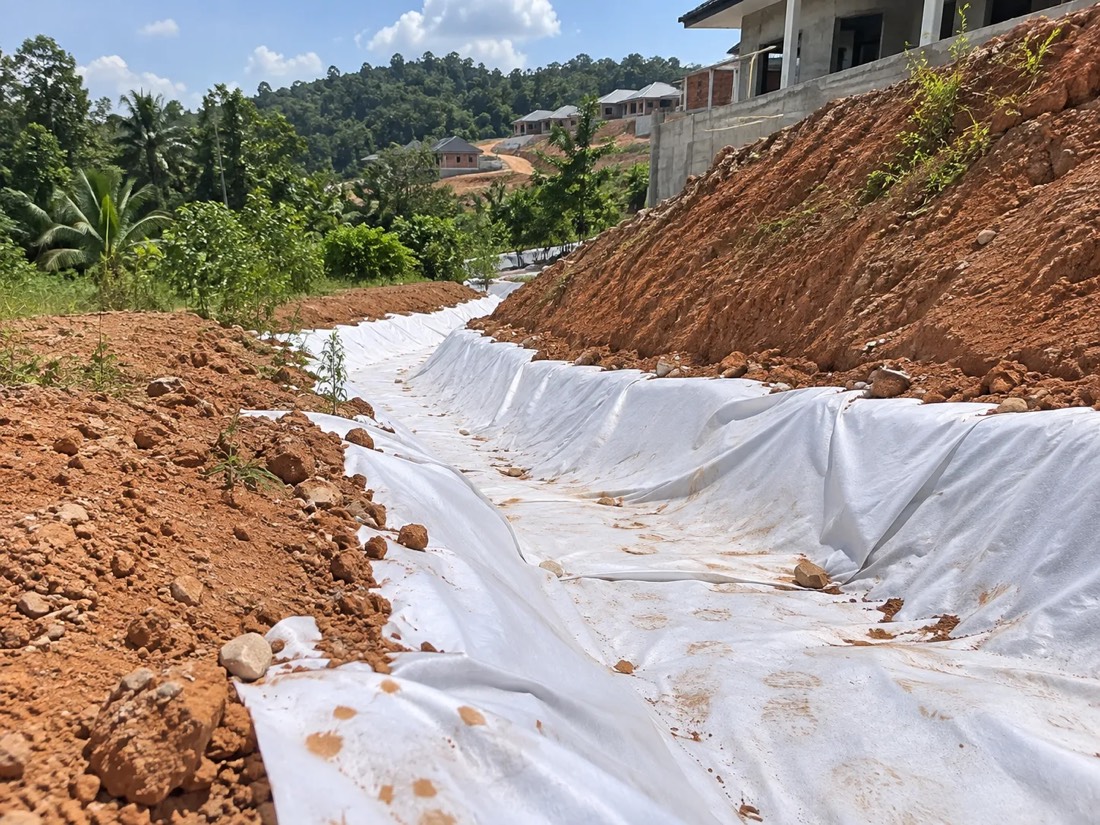
The short answer
Trim the channel or slope, lay non-woven geotextile down the slope with the upper sheet overlapping the lower by 300 to 500 mm, anchor it in a trench at the top, then place the stone or rock from the bottom up without dropping it. 190 to 250 gsm (ATX40 to ATX60) is the usual range.
Where the fabric goes in a slope drain.
The geotextile lines the trimmed soil under the stone. Water seeps through it into the drain; the soil behind stays put, so the drain isn't undermined. At the top, the fabric is buried in an anchor trench so it can't slide.
- Trimmed slope soil
- Non-woven geotextile, anchored at the top
- Stone pitching or rock
- Water
How to build it, step by step.
Trim the slope or channel
Cut the channel or slope face to an even shape. Remove roots, sharp stones and loose soil.
Dig the anchor trench
Dig a small trench along the top edge, about 300 mm deep, to bury the top of the fabric.
Roll the fabric down the slope
Lay the geotextile down the slope, not across it, in close contact with the soil. Don't leave it bridging over hollows.
Overlap in the right direction
Overlap side joins by 300 to 500 mm. Where one sheet meets another down the slope, the upper sheet goes over the lower, like roof tiles.
Anchor and pin
Bury the top of the fabric in the anchor trench and pin it down the slope so it can't move while you work.
Place the stone from the bottom up
Place stone, rock or blocks starting at the toe and working upwards. Don't drop heavy rock from height onto the fabric.
Finish the edges
Tuck the fabric edges into the ground or under the stone at the sides so water can't get behind them.
How much fabric do you need?
ATX40 to ATX60 come in 4 m or 6 m wide rolls. For a channel, the fabric covers the base, both sides and a 300 mm apron at each top edge.
| Channel (base × depth) | Fabric width needed | Fabric per 10 m of channel |
|---|---|---|
| 0.45 × 0.3 m | about 1.7 m | about 18 m² |
| 0.6 × 0.45 m | about 2.1 m | about 23 m² |
| 1.0 × 0.6 m | about 2.8 m | about 31 m² |
| Open slope with rock, 100 m² | — | about 114 m² (4 m rolls) |
Send us the drain sizes or slope area and we'll work out the roll width and number of rolls.
Which grade for slope drains?
Stone and flowing water wear the fabric, so slopes need a heavier grade than gardens.
- Small stone-lined drains and channels
- 190 gsm (ATX40), to order.
- Slope drains and channels with larger stone
- 210 to 250 gsm (ATX50, ATX60), to order.
- Rock armour, riverbanks, heavy rip-rap
- Follow the engineer's specification; heavy rock may need 350 gsm or more.
- Supply
- ATX40 to ATX60 come in 4 m or 6 m wide rolls, supplied to order.
- Catalogue
- Download the AeroTex catalogue (includes the data sheet). Test reports on request.
Why slope drains get undermined.
When drains crack and stone slides, it usually comes down to one of these.
- No fabric under the stone · water washes soil out from under the lining
- Overlaps facing the wrong way · water runs under the joint instead of over it
- No anchor trench at the top · the fabric slides down the slope
- Rock dropped from height · it punctures the fabric
- Fabric bridging over hollows · it tears when the stone loads it
Drainage, not stability.
Geotextile under a slope drain or rock protection stops soil being washed out. It doesn't hold a slope up.
If a slope is cracking, bulging or has already slipped, that is a stability problem for a geotechnical engineer, who may specify soil nails, reinforcement, geogrid or woven geotextile. See woven vs non-woven.
Drains our customers have built.
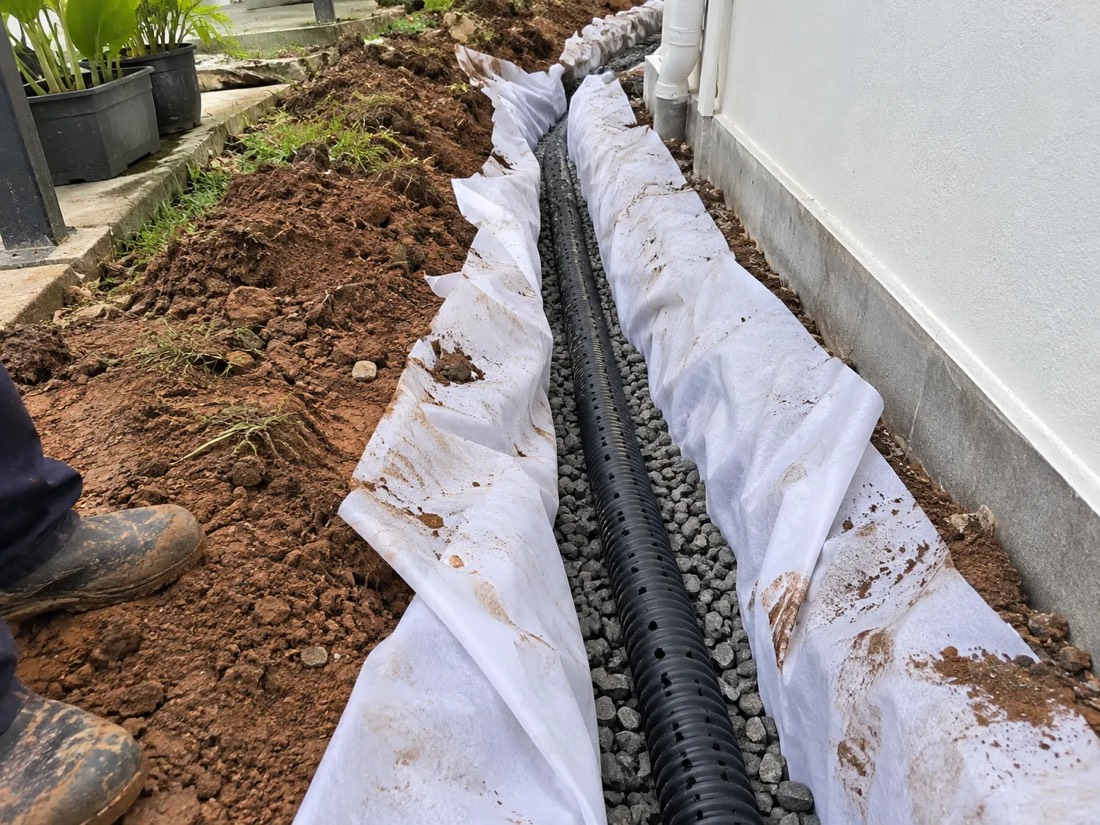
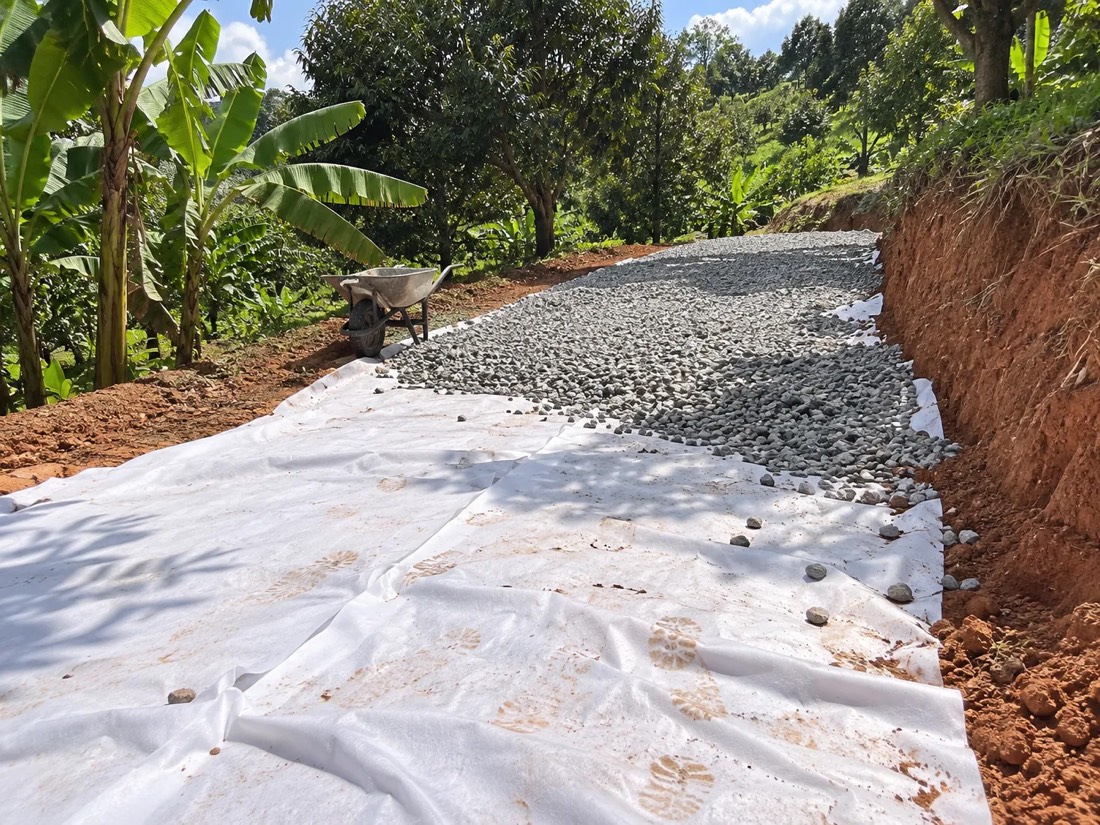
Slope drain questions.
Why put geotextile under a slope drain?
Water flowing in and around the drain washes fine soil out from underneath, so the lining cracks and collapses. Geotextile lets water through but holds the soil in place.
Which way should geotextile overlap on a slope?
Lay sheets down the slope. Where sheets meet, the upper sheet overlaps the lower one, like roof tiles, so water flows over the joint, not under it.
What gsm geotextile for slope drains?
190 to 250 gsm (ATX40 to ATX60) for slope drains and channels. Heavy rock protection follows the engineer's specification.
Does geotextile stabilise a slope?
Non-woven geotextile under drains and rock stops erosion; it doesn't hold up an unstable slope. A slipping slope needs a geotechnical engineer.
Can I put geotextile under concrete slope drains?
Yes. Laid under precast or cast drains, it stops soil washing out from beneath and behind them.
How do I stop the fabric sliding down the slope?
Bury the top in an anchor trench about 300 mm deep and pin it down the slope until the stone is on.
Where can I buy geotextile for slope drains in Malaysia?
AeroTex supplies ATX40 to ATX60 to order in 4 m or 6 m wide rolls, with nationwide delivery. Send the drain sizes and location on WhatsApp for a price.
Working on slope drains? Send us the sizes.
Tell us the drain sizes or slope area and the delivery location. We reply with the grade, roll width, number of rolls and today's price.
 © 2026 AeroTex™ Non-woven Geotextile. Made in Malaysia.
aerotex.my