Geotextile for farm and estate roads.
Farm and estate roads on clay turn into ruts and mud every monsoon, and the stone you spread disappears into the ground. Laying non-woven geotextile under the stone keeps it on top, so the road stays passable and needs less topping up.
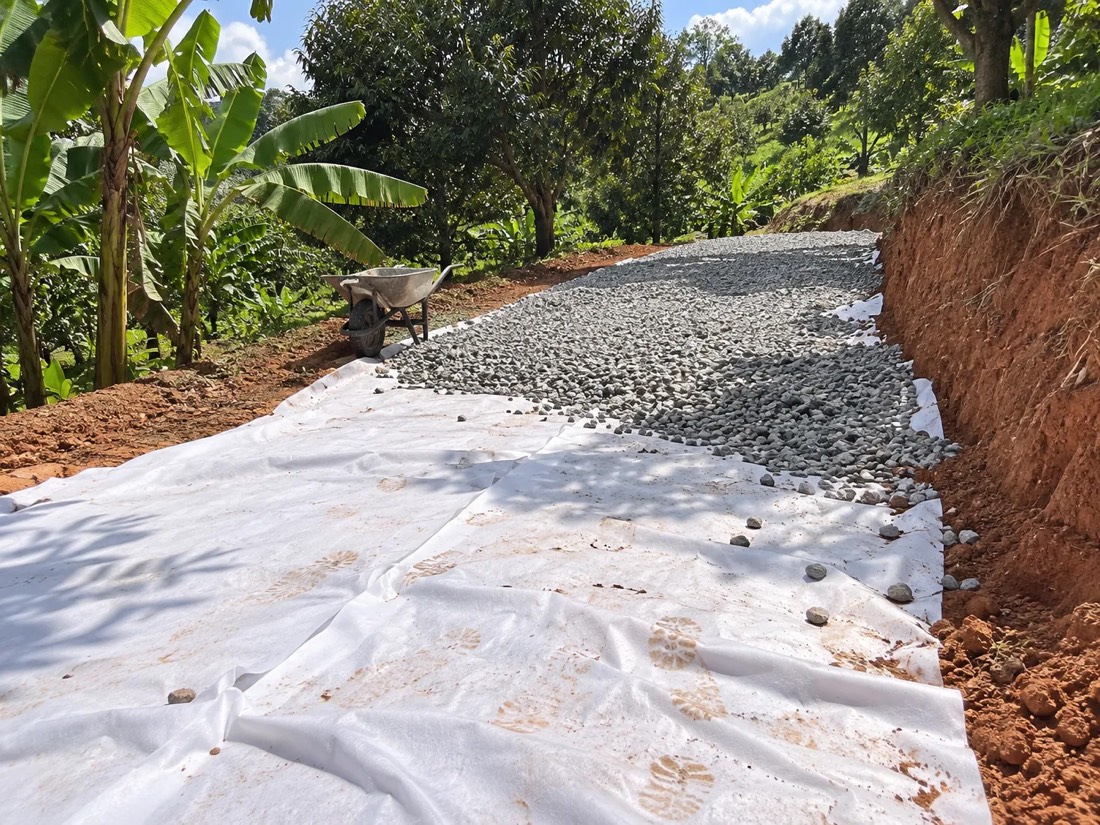
The short answer
Clear and shape the road with a camber and side drains, compact the soil, roll non-woven geotextile along the road with 300 to 500 mm overlaps, then spread and compact crusher run or quarry stone on top. Farm and estate roads usually take 250 gsm (ATX60); on very soft ground, ask an engineer.
What goes under a gravel farm road.
The fabric sits on the shaped, compacted soil under all of the stone. The camber and side drains get water off the road; the fabric stops the stone being pushed into the soil by lorries and tractors.
- Shaped and compacted soil
- Non-woven geotextile
- Crusher run or quarry stone
- Side drains
How to build it, step by step.
Clear the route
Remove vegetation, roots and the soft top layer along the road line.
Shape a camber
Shape the road higher in the middle so rain runs off to both sides. A flat road holds water and softens.
Dig side drains
Cut drains along both sides with outlets, so water leaves the road instead of soaking into it.
Compact the soil
Compact the shaped soil. Dig out very soft or wet patches and fill with better material.
Roll out the geotextile
Roll the fabric along the road, covering the full width of the stone. Overlap joins by 300 mm, or 500 mm on soft ground.
Spread the stone
Tip stone onto stone already spread and push it forward, so lorries never drive on bare fabric.
Compact
Spread and compact the crusher run or quarry stone in layers to the full depth, keeping the camber.
Maintain
Keep the side drains clear and fill potholes early, before water gets into the base.
Which roll width, and how much?
ATX50 and ATX60 come in 4 m or 6 m wide rolls. Choose the width that covers the stone in one strip where you can.
| Road width (stone) | Roll width | Fabric per 100 m of road |
|---|---|---|
| 3 m | 4 m, one strip | about 420 m² |
| 3.5 m | 4 m, one strip | about 420 m² |
| 5 m | 6 m, one strip | about 630 m² |
| 7 m | two 4 m strips, 500 mm overlap | about 840 m² |
Send us the road length, width and location, and we'll work out the rolls. For short access paths and garden tracks, the 2 m wide ATX20 rolls may be enough.
Which grade for a farm road?
Farm and estate roads carry lorries, tractors and sharp stone, so they need a heavier grade than gardens.
- Light farm tracks and footpaths
- 210 gsm (ATX50).
- Farm, orchard and estate roads with lorries
- 250 gsm (ATX60).
- Very soft clay, peat or swampy ground
- Ask an engineer: woven geotextile, geogrid or a heavier non-woven may be needed. See woven vs non-woven.
- Supply
- ATX50 and ATX60 come in 4 m or 6 m wide rolls, supplied to order.
- Catalogue
- Download the AeroTex catalogue (includes the data sheet). Test reports on request.
Why farm roads keep breaking up.
Ruts, potholes and lost stone usually come from one of these.
- No camber or side drains · water stays on the road and softens the soil underneath
- Stone straight on clay · it gets pushed into the soil and you keep buying more
- Driving on bare fabric · wheels tear and shift it before the stone is on
- Overlaps too small on soft ground · strips separate and mud pumps up between them
- Potholes left to grow · water gets in and the base fails faster
Is it worth it on a farm road?
On firm, well-drained ground, a crusher run road can last without fabric. On clay and wet ground, which is most of Malaysia's farm and estate land, the stone is slowly lost into the soil and has to be topped up again and again.
The fabric keeps that stone on top. Over a few seasons, the stone you don't have to buy again usually pays for the fabric.
Roads and yards our customers have built.
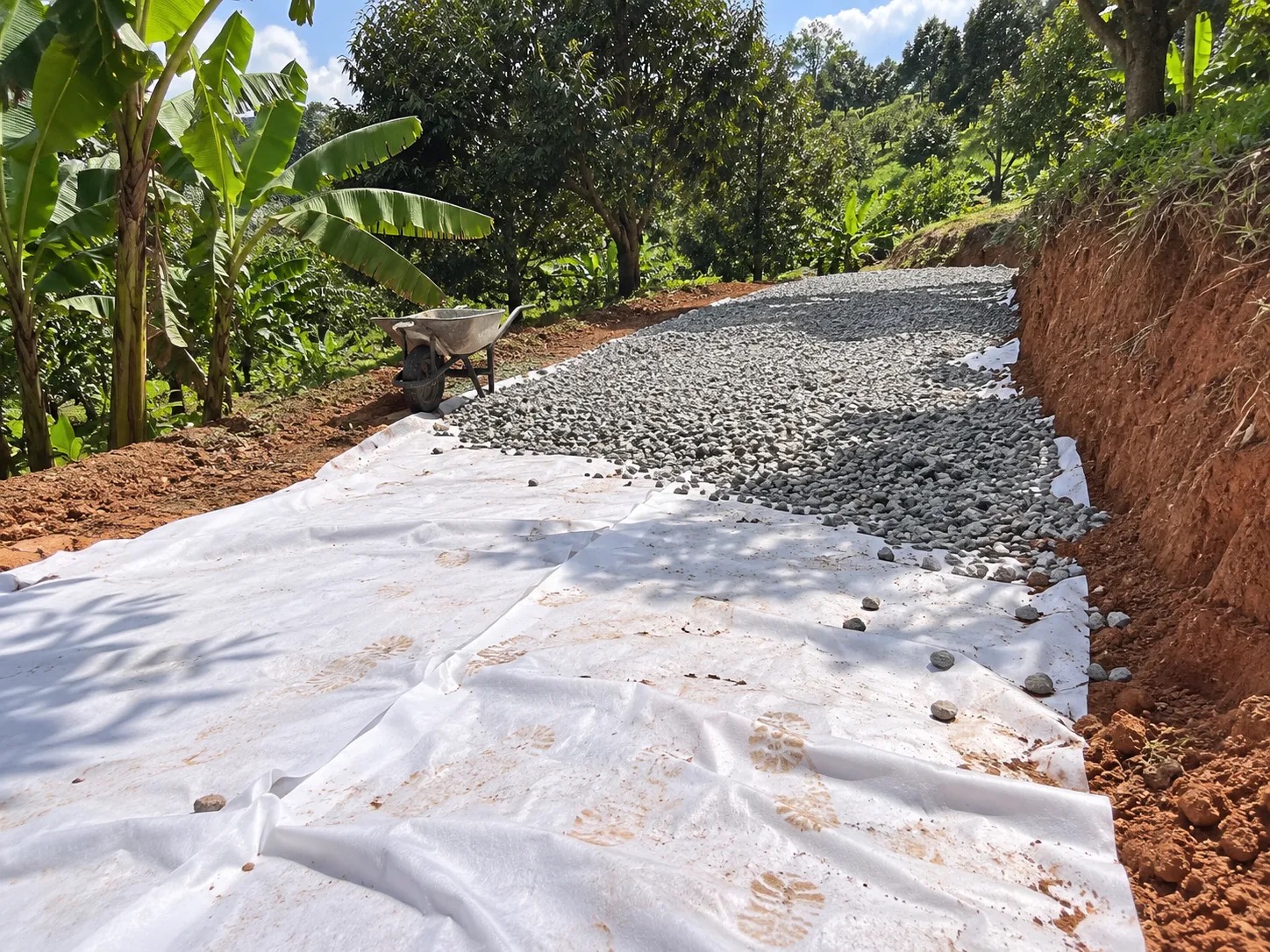
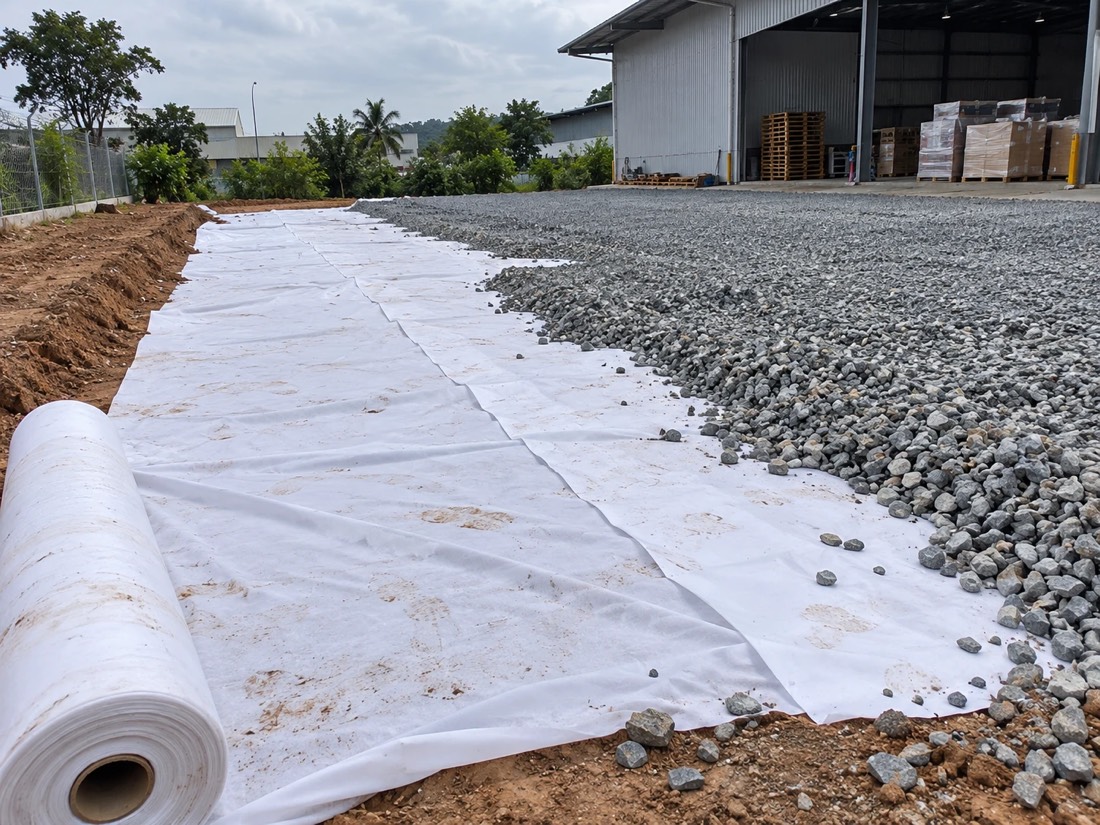
Farm road questions.
Do I need geotextile for a farm road?
On clay or wet ground, yes. Without it, crusher run and quarry stone get pushed into the soil by lorries and tractors, and the road ruts and needs constant topping up. On firm, dry ground it is less critical.
What gsm geotextile for a farm or estate road?
250 gsm (ATX60) is the usual grade for farm, orchard and estate roads that carry lorries. Light tracks can use 210 gsm (ATX50).
Woven or non-woven for a farm road?
On normal farm ground, non-woven separates the stone from the soil and lets water drain. On very soft clay, peat or swamp, an engineer may specify woven geotextile or geogrid. See woven vs non-woven.
How wide are the rolls?
ATX50 and ATX60 come in 4 m or 6 m wide rolls. A 4 m roll covers a road up to about 3.7 m wide in one strip; a 6 m roll covers up to about 5.7 m.
Can I use quarry dust or laterite on top?
Yes. The fabric goes under whatever road material you use. Crusher run gives the firmest surface; laterite and quarry dust need good camber and drains.
How much overlap do I need?
300 mm on firm ground and 500 mm on soft ground, at both side joins and roll ends.
Where can I buy geotextile for farm roads in Malaysia?
AeroTex supplies ATX50 and ATX60 to order in 4 m or 6 m wide rolls, with nationwide delivery. Send the road length, width and location on WhatsApp for a price.
Building a farm road? Send us the length and width.
Tell us the road length, width, what drives on it and the location. We reply with the grade, roll width, number of rolls and today's price.
 © 2026 AeroTex™ Non-woven Geotextile. Made in Malaysia.
aerotex.my