Geotextile for driveways and house compounds under crusher run.
A crusher run driveway or compound sinks and goes muddy when the stone gets pushed into the soil underneath. A layer of non-woven geotextile between the soil and the crusher run keeps the two apart, so the base holds its level and drains after rain.
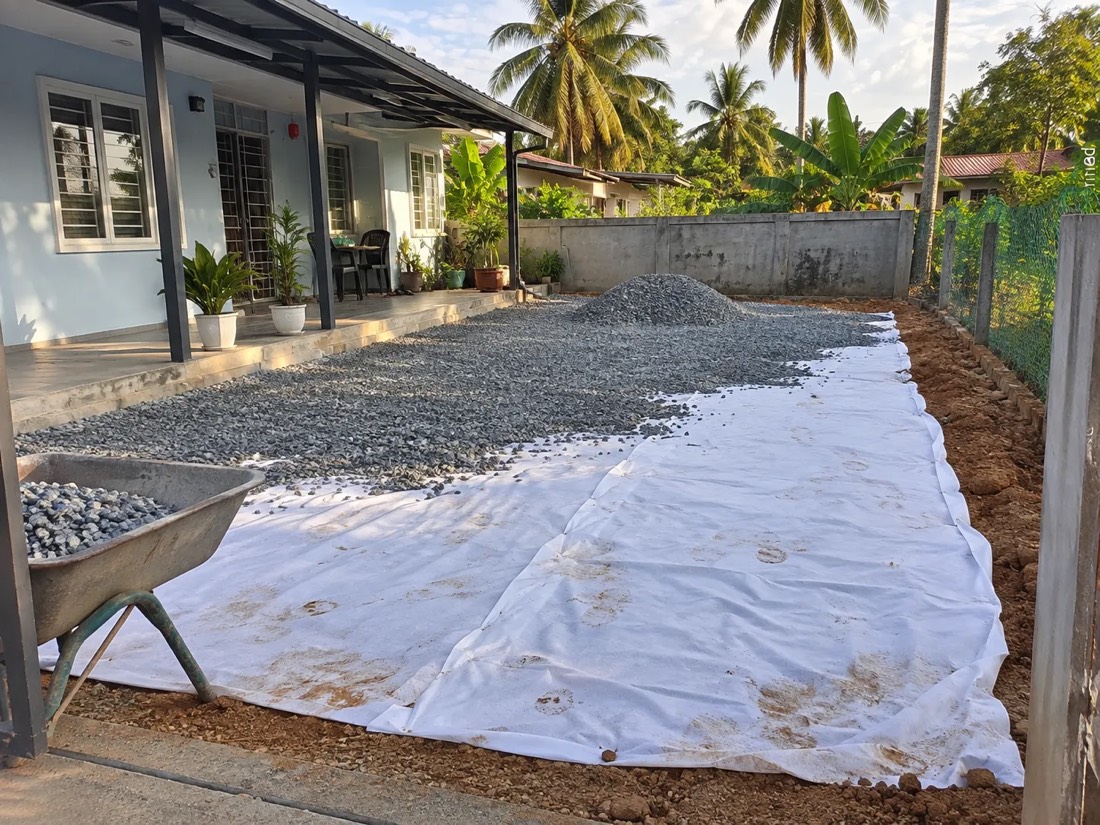
The short answer
Strip the topsoil, level and compact the ground, roll out non-woven geotextile with 300 mm overlaps (500 mm on soft ground), then spread and compact the crusher run on top in layers. For house compounds and car porches, 190 to 210 gsm (ATX40 or ATX50) is the usual grade; yards that take lorries use 250 gsm (ATX60).
What goes under a crusher run driveway.
The fabric sits on the compacted soil, under all of the stone. It stops the crusher run mixing into the soil and lets rainwater drain down instead of pooling in the base.
- Compacted subgrade soil
- Non-woven geotextile
- Crusher run, compacted in layers
- Optional surface: premix, pavers or concrete
How to lay it, step by step.
Mark out and dig
Remove grass, roots and soft topsoil over the whole area. Dig deep enough for the crusher run plus any surface layer.
Shape the fall
Give the ground a slight fall away from the house and towards a drain, so rainwater leaves the compound instead of sitting in it.
Compact the soil
Compact the exposed soil with a plate compactor or roller. Dig out and replace any very soft or wet spots.
Roll out the geotextile
Roll the fabric across the area with no folds or wrinkles. Overlap side-by-side strips by at least 300 mm, or 500 mm on soft ground. Turn the edges up against walls and kerbs.
Tip and spread the stone
Tip the crusher run onto stone already spread, not straight onto bare fabric, and push it forward with the loader. Don't drive on the fabric before it is covered.
Compact in layers
Spread and compact the crusher run in layers of about 100 mm until you reach the full depth.
Finish the surface
Leave the crusher run as the surface, or lay premix, interlocking pavers or concrete on top.
Keep the drains clear
Make sure the edge drains and outlets take water away; a well-drained base lasts much longer.
How much fabric do you need?
Heavier grades come in 4 m or 6 m wide rolls. Overlaps use up part of each strip, so you need a little more fabric than the area.
| Area to cover | Fabric with 4 m rolls | Fabric with 6 m rolls |
|---|---|---|
| 100 m² (small car porch) | about 114 m² | about 111 m² |
| 200 m² | about 227 m² | about 221 m² |
| 500 m² (house compound) | about 568 m² | about 553 m² |
| 1,000 m² (yard) | about 1,135 m² | about 1,105 m² |
Send us the area and we'll work out the roll width and number of rolls. For small garden paths, the 2 m wide ATX20 rolls are easier to handle; use the roll calculator.
Which grade for a driveway?
Pick the grade for the load and the ground. Heavier traffic and sharper stone need a heavier fabric.
- Footpaths and light car porches
- 190 gsm (ATX40).
- House compounds and driveways
- 210 gsm (ATX50).
- Yards, lorries and soft ground
- 250 gsm (ATX60).
- Very soft clay or peat
- Ask an engineer. Where the fabric has to help carry the load, a woven geotextile or geogrid may be specified; see woven vs non-woven.
- Supply
- ATX40 to ATX60 come in 4 m or 6 m wide rolls, supplied to order.
- Catalogue
- Download the AeroTex catalogue (includes the data sheet). Test reports on request.
Why crusher run driveways fail.
Most sinking, rutting and muddy compounds come down to one of these.
- No fabric under the stone · crusher run works down into the soil and the surface sinks
- Soft spots left in · soft soil under the base turns into potholes
- Overlaps too small · strips pull apart and soil pushes up between them
- Driving on bare fabric · tyres tear it and drag it out of place
- No fall or drainage · water sits in the base and softens the soil
Is geotextile worth it under crusher run?
The fabric is a small part of the cost of a compound, and the crusher run is the big part. Without fabric, the bottom of the crusher run slowly mixes into the soil, so you end up topping up stone every year or two as the surface sinks.
With fabric, the full depth of stone stays where you put it. That matters most on clay and wet ground, which covers much of Malaysia.
Compounds and yards our customers have built.
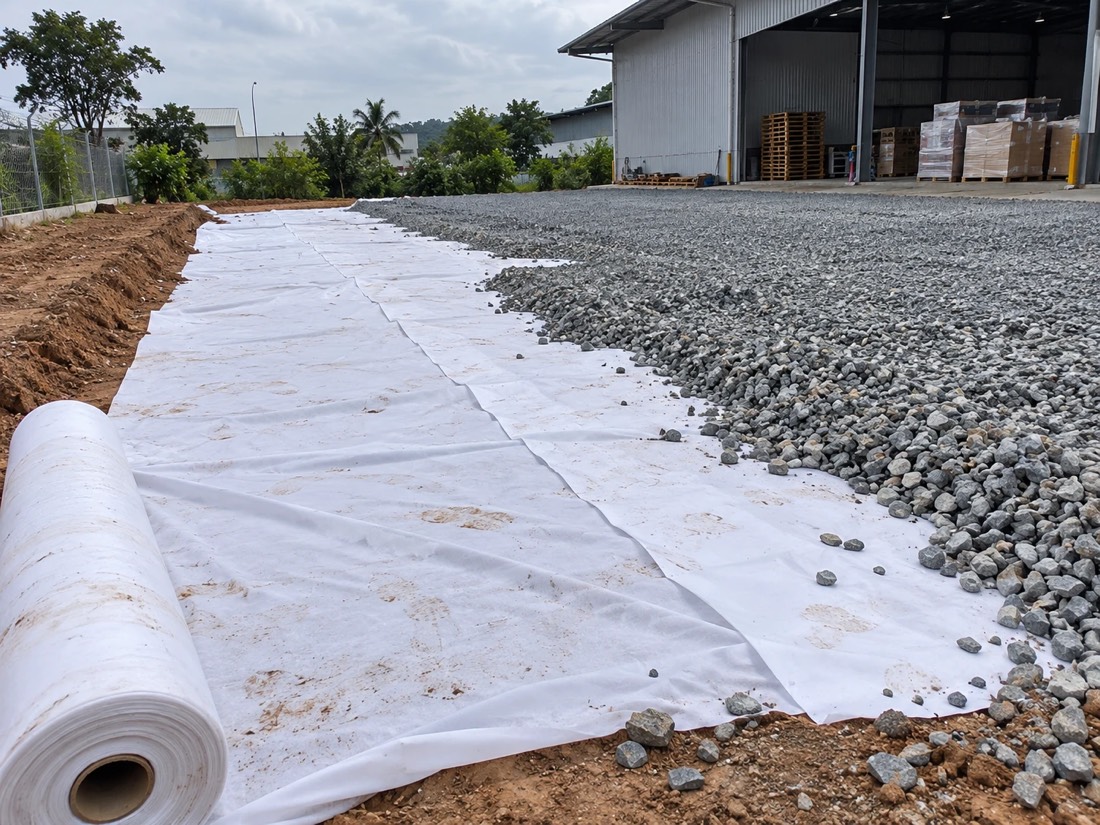
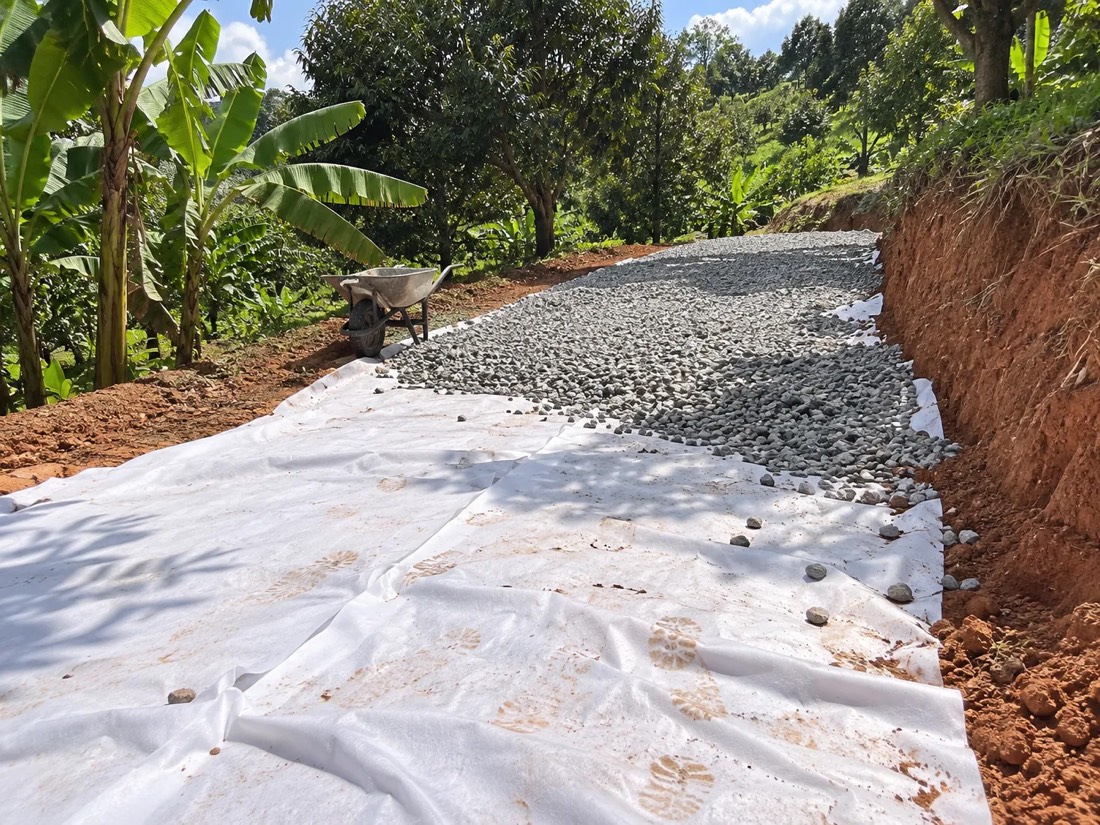
Driveway questions.
Do I need geotextile under crusher run?
On most Malaysian soils, yes. Without it, the crusher run slowly sinks into the soil, especially on clay and after heavy rain. A non-woven geotextile keeps the stone and soil apart so the base keeps its level.
What gsm geotextile for a driveway?
For house compounds and driveways, 210 gsm (ATX50) is a common choice. Light car porches and footpaths can use 190 gsm (ATX40). Yards that take lorries, or soft ground, use 250 gsm (ATX60).
How thick should crusher run be for a driveway?
It depends on the soil and the traffic. For cars on firm ground, 100 to 150 mm of compacted crusher run is typical; lorry yards and soft ground need more. Follow your contractor or engineer for the exact depth.
Woven or non-woven under a driveway?
On firm ground, non-woven: it separates the stone from the soil and lets water drain. On very soft clay or peat, an engineer may specify woven geotextile or geogrid. See woven vs non-woven.
How much overlap do I need?
At least 300 mm between strips on firm ground, and 500 mm on soft ground. Overlap the end of one roll over the start of the next in the direction the stone is pushed.
Can I put geotextile under premix or pavers?
Yes. Lay it under the crusher run base, not directly under the premix or pavers. The fabric protects the base, and the base supports the surface.
Where can I buy geotextile for a driveway in Malaysia?
AeroTex makes non-woven geotextile in Seremban and supplies ATX40 to ATX60 to order in 4 m or 6 m wide rolls, with nationwide delivery. Send the area and location on WhatsApp for a price.
Doing a driveway or compound? Send us the area.
Tell us the area, what will drive on it and the delivery location. We reply with the grade, roll width, number of rolls and today's price.
 © 2026 AeroTex™ Non-woven Geotextile. Made in Malaysia.
aerotex.my